top of page


HYDROSONIX
The Challenge
Dehydration is a leading cause of preventable hospitalization, causing billions of dollars in hospitalization costs in the United States annually. Although dehydration is treatable, it is often not detected in time.
Our Goal
Develop a low-cost, noninvasive device to diagnose dehydration via tissue stiffness information gathered using ultrasound.

2025 SEBA Science and Technology Showcase

2026

Clinical Ultrasound Machine (EPIQ): used for measuring phantom stiffness and shear modulus
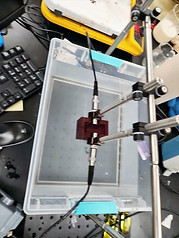
Instrumentation Proof-of-Concept setup: transducers across from each other (silver) with phantom holder (brown) in between
Previous Progress Milestones
-
PVA phantom shear modulus is within physiological ranges
-
Phantom library expanded to include Gelatin and Agar recipes
-
Simulation modeling shows Normalized Cross-Correlation (NCC) and Time-to-Peak (TTP) data analysis yield most robust predictions
-
Instrumentation prototype demonstrates preliminary proof-of-concept (ability to detect signal through phantom)
Current Goals
-
Refine and iterate instrumentation prototype toward consistent measurements
-
Work towards parallel transducer configuration
-
Continue expansion of phantom library to mimic stiffness range of human tissues
-
Refine simulation to mimic instrumentation setup as closesly as possible

Jar of phantoms

Parallel Transducer Prototype CAD Model
Hydrosonix's Work is Divided Between Three Main Subteams
Team Leads
Maya Ellgass - ellgassm@uw.edu
Saadgi Garg - sg140628@uw.edu
Becky Matthews - rsmath88@uw.edu
Special thanks to PhD graduate Connor Krolak for his invaluable leadership from 2020 to 2026

-
Phantom Creation (wet lab)
-
Literature Research
-
EPIQ Ultrasound Measurements

-
Prototyping
-
Signal Acquisition (function generator, oscilloscope, LabVIEW)
-
CAD Modelling

-
MATLAB
-
Data visualization
-
Sanity-check Instrumentation team data

bottom of page